Here is an uncomfortable truth about small business in the UK: fewer than 28% of businesses survive more than ten years, and only one in ten makes it past twenty. Those statistics have barely moved in decades.
That is not bad luck. That is a pattern. And patterns have causes.
In my experience, spanning more than forty years working closely with small business owners, the cause is almost always the same. Most businesses are built to handle today. They are not built to survive tomorrow.
The Trap of the Here and Now
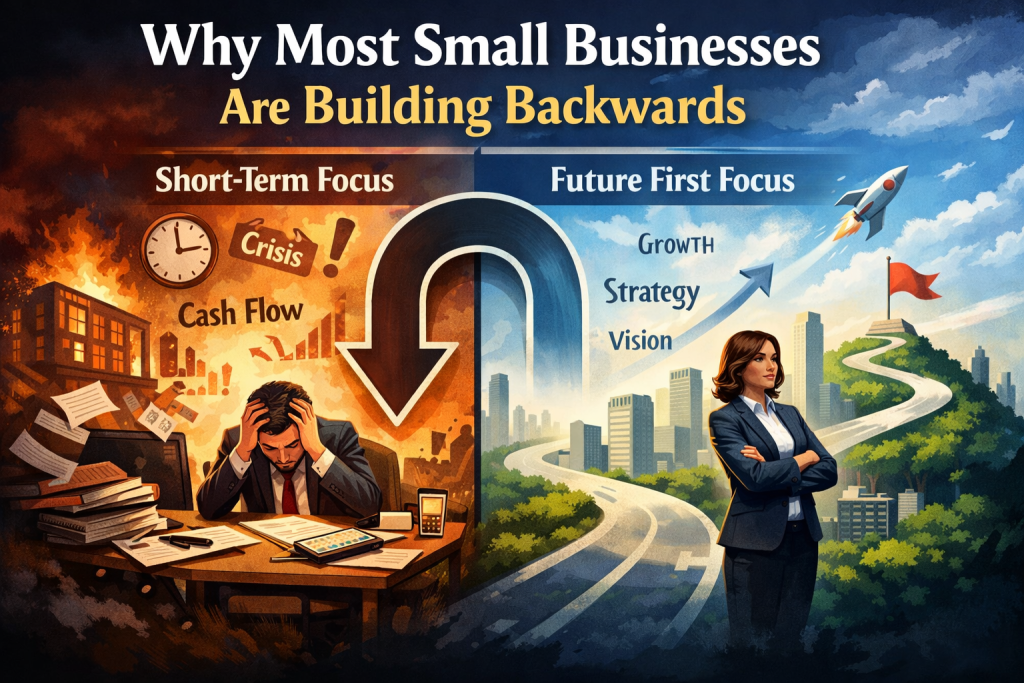
When you run a small business, every day is a sprint. You are managing cash flow, serving clients, keeping your team together, and dealing with whatever unexpected problem arrived that morning. The immediate is relentless, and your attention goes where the pressure is loudest.
This is entirely natural. But it is also dangerous.
A business that is optimised purely for survival in the next quarter is not positioned to withstand the disruptions that are coming in the next couple of years. Markets shift. Technology moves. Customer expectations change. Competitors emerge from directions you did not anticipate. If your entire focus is on fighting today's battles, you will not have built the foundations to survive tomorrow's.
I call this the reactive business model, and it is far more common than most business owners would like to admit.
What a Future First Business Actually Is
A Future First Business is one that is well-positioned to succeed regardless of the challenges and changes that may come.
Notice what that definition does not say. It does not say a business that has predicted the future as no one can do that. It does not say a business that has avoided all risk. It says a business that is ‘positioned’ to succeed whatever comes next. That positioning is something you can deliberately build, step by step, right now.
The shift is fundamentally one of sequence. Most businesses think about the future last, if at all, once the urgent work is done, once cash flow is stable, once things calm down a little. Of course, things never calm down, so the future never gets the attention it needs.
A Future First Business reverses that sequence. The future informs every decision made today. Where are we trying to go? What kind of business do we need to become? And then what do we need to do this week to move in that direction?
It sounds simple. It is not easy. But it is learnable, and it is practical.
The Three Stages of the Journey
Building a Future First Business is not one big leap. It is a structured progression through three stages: Strengthen, Optimise, and Transform.
Strengthen comes first, and it is where most businesses need to begin. Before you can grow, you need a solid foundation. That means examining your attitude, the mindset you bring to challenges, setbacks and decisions. It means making better decisions more consistently, not relying on instinct alone. And it means protecting what you have already built, because far too many business owners reach the end of a successful run only to discover they have ringfenced nothing.
Optimise is the second stage, and it is where the practical levers of business performance sit. Cash is the lifeblood of any business, not profit on paper, but actual cash in the bank. Knowledge matters too: the difference between a business owner who has information and one who has turned that information into genuine wisdom is enormous. This stage also covers control, knowing where your profit actually goes, why your systems are or are not being followed, and how to stabilise the business so it stops haemorrhaging money in ways you have not yet noticed.
Transform is the final stage, and it is where a business moves from surviving to building something lasting. Progress with purpose: a clear sense of where you are going, a strategy for getting there, and a plan that you actually review and act on. People: because the best systems in the world are worthless without the right team to run them. And systems: the documented, repeatable processes that allow your business to produce consistent results without depending entirely on you.
The Question at the Heart of It
There is a question I ask every business owner I work with, and I have been asking it for a long time: “If you stepped away from your business for six months, what would happen?”
For most owners, the honest answer is difficult. The business would struggle. Maybe it would survive. But it would not thrive, because too much of what makes it work lives inside the owner's head, or depends on the owner's presence, or cannot function properly without the owner's daily intervention.
That is not a business. That is a job, one you have built around yourself and cannot leave.
A Future First Business is different. It has systems that produce consistent results. It has a team that can operate without constant supervision. It has a clear direction that guides decisions even when the owner is not in the room. And it has an owner who can, when the time comes, step back, whether for a week, a year, or permanently.
Building that kind of business is the work. It takes time, and it requires addressing things that most business owners find uncomfortable. But the alternative, carrying on as you are and hoping the statistics do not apply to you, is not much of a strategy.
Peter Disney is the Managing Director of Wood & Disney, award-winning chartered accountants and business advisors based in Colchester, Essex. His book, The Future First Business: A Practical Workbook, is available now on Amazon.
Wood & Disney specialise in helping ambitious entrepreneurs build businesses that last. www.woodanddisney.co.uk